































Home |
Aim & Scope | Editorial Board | Call for Paper | Instruction for Authors |
| Contact Us | Open Access | Indexing & Archiving |
| Help & Support | Downloads | Paper Submission |






Referees' evaluations usually include an explicit recommendation of what to do with the manuscript or proposal, often chosen from
options provided by the journal. Most recommendations are along the lines of the following: |
· |
to unconditionally accept the manuscript or proposal, |
· |
to accept it in the event that its authors improve it in certain ways, |
· |
to reject it, but encourage revision and invite resubmission, |
· |
to reject it outright. |
IJAET follows a strict blind peer-review program, wherein the reviewers are not aware of the identities of the authors of the papers
which are being reviewed by them. This policy is a recent amendment to the existing set of guidelines so as to prevent any sort of
favoritism. The IJAET reviewers are selected after thorough screening process. IJAET has a process of inviting applications from
prospective reviewers. However, the publisher also individually contacts and invites competent individuals to join the esteemed board
of IJAET reviewers. |
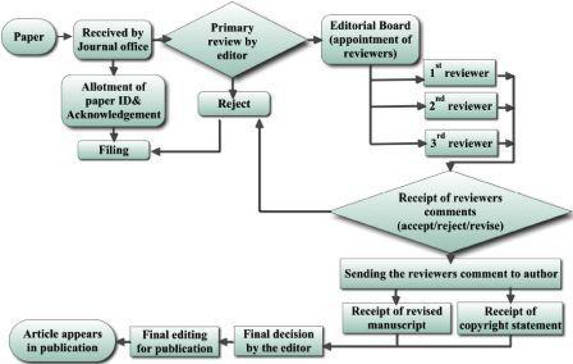

Peer review is the process of subjecting an author's scholarly work, research, or ideas
to the scrutiny of others who are experts in the same field. Peer review requires a
community of experts in a given (and often narrowly defined) field, who are qualified
and able to perform impartial review. Impartial review, especially of work in less
narrowly defined or inter-disciplinary fields may be difficult to accomplish; and the
significance (good or bad) of an idea may never be widely appreciated among its
contemporaries. |
| · | Definition and Context |
|
| Notifying IJAET about Alleged Plagiarism | |
| Deliberation | |
| Results of Deliberation | |
· |
Penalties for Plagiarism |